Research
Barriers constraining ethnic minority women's progression into Senior Civil Service roles in the MOD
Abstract
An examination of the organisational barriers that constrain ethnic minority women from progressing into Senior Civil Service roles in the UK Ministry of Defence — then the least representative department in the Civil Service. Drawing on quantitative and qualitative research, it identifies four themes — organisational structures, language, culture and leadership — and sets out nine recommendations to widen the pipeline.
Executive Summary
The Ministry of Defence (MOD) was the least representative Civil Service (CS) department for both gender and ethnic diversity in the Senior Civil Service (SCS) as at March 2021 (GOV.UK, May 2022). The issue isn’t unique to Defence, gender and ethnic diversity in senior leadership is challenging the CS and private sector alike. Studies show ethnic diversity provides a greater return on investment over gender diversity (McGregor-Smith, 2017 and McKinsey, 2022). Yet, businesses continued to prioritise the gender campaign, leaving people of colour disadvantaged (Parker Review, 2016).
The Defence Command Plan (2021) recognises people are its finest assets. The Defence Diversity and Inclusion Strategy (2018-2030) aspires for an organisation that ‘at all levels, appropriately represents UK Society’. Yet progress is slow with ethnic minority demographics increasing faster across society than Defence.
Secondary literature suggests ethnic minority women, particularly Black African, are at a risk of suffering the impact of ‘occupational double jeopardy’ (Beal, 1970; and Perry, 1970; cited in Kamenou 2007). The Race Disparity Report (2021) finds half of Pakistani and Bangladeshi women are economically inactive compared to white women. Women more broadly, are challenged, as primary carers, by the ‘double-burden’ effect (McKinsey, 2017). Therefore, one cannot assume the lived experience of all ethnic minority women is the same (CIPD, 2017; Inclusive Companies) or different from other, white ethnic groups (Bhavnani 1994, cited in Kamenou 2007).
The lack of disaggregation beyond ‘ethnic minority’, constrains Defence’s ability to assess whether particular sub-cultural groups are uniquely underrepresented. The disclosive nature of this data means it is yet not possible to break this down further.
This study took a top-down view to explore organisational barriers constraining ethnic minority women from progressing into SCS roles. It drew on its findings and wider research to inform nine recommendations Defence could take to increase ethnic minority women in SCS roles. Organisational Structures, Language, Culture and Leadership were the key themes uncovered by this study.
Organisational Structures
The internal SCS pipeline is too small. Considering c70 percent of applicants for MOD SCS roles are internal candidates, suggests this is a wicked problem. There were blind spots to this finding. Across the MOD civilian workforce, those choosing not to declare or failed to disclose their diversity were double the number of those who declared themselves ethnic minority, suggesting the true ethnic minority SCS pipeline is unknown. The lived experience still suggests EM women, particularly those in SCS positions, are unfamiliar which results in the wider workforce having to work harder to overcome their own bias.
There is a perception there aren’t many SCS opportunities across Defence, so people leave for other government departments. Non-parametric tests rejecting this hypothesis confirming there is no relationship between SCS headcount and levels of diversity.
Location transpired as a barrier to progression. MOD workforce data by region was overlaid with Census 2021 ethnic minority demographics which found the infrastructure of Defence is sub-optimally configured to draw on the most diverse talent pool from across the country.
Language
MOD SCS job adverts failed to meet the standard inclusive and effective language criteria, according to Textio, an artificial intelligence tool. It found social bias was prevalent across most jobs posted between Dec 22-Feb 23. Job specifications were overly masculine and long which was concerning considering LinkedIn research found women were 16 percent less likely to apply for a job when presented with heavy job requirement (Werber, 2019). This was reinforced in the qualitative findings where an SCS woman concurred job adverts were too long and onerous with women likely to hit crisis of confidence.
Culture
Bias was prevalent across many parts of the organisation impacting EM women everywhere. White ethnic women equally reported instances of bias on their journey to the SCS. Ethnic minority and white women continue to experience bias in their lived experience today.
Defence recognises it has a problem, evident from the Wigston Review (2019) and continues to progress its ambition to improve the culture by stamping out unacceptable behaviour.
Leadership
Receiving feedback, one cannot work with from leadership delayed the progression of one EM SCS woman. Wider literature suggests ‘soft feedback’ is the unintended consequence for fear of seeming sexist or racist. Qualitative analysis did find there was a slight paranoia and fear of offending others from senior leadership. This doesn’t take-away from the commitment and buy-in MOD senior leaders display for the diversity agenda. Its middle managers who potentially need to be brought into this space more.
Those who did make it into the SCS described themselves as ‘thick skinned’, had great line managers, applied for development programmes and learnt how to network, all of which takes a very bottom-up approach to progression.
Summary
Primary and secondary findings suggest Defence needs to take a more top down, two-pronged approach, increase representation and shift cultures. Defence could collaborate more across government and industry on diversity, provide better SCS job writing guidance, increase connectivity between senior leaders and EM workforce, introduce flexible location recruitment, focus on outreach for ethnic minority women into SCS, and a leadership development programme for its ethnic minority G6-G7 workforce. To improve the lived experience, culture, and ultimately the internal SCS pipeline, gender and ethnic diversity needs to breed at every level across Defence.
Introduction
The Ministry of Defence (MOD) is one of the ‘big five’ government departments employing two thirds (59,900) of civil servants (GOV.UK, 2022), spending £1.6 billion on its civilian workforce (GOV.UK) last year. MOD protects the nation, and its people, operating across land, air, sea, space and cyberspace. MOD, which also includes military and contractor personnel, recognises workforce diversity is a key strategic enabler in the Defence outcome delivery plan 2021-22.
MOD is, however, the least representative department across the Civil Service (CS) both on gender (32.6 percent) and ethnicity (2.9 percent) in Senior Civil Service (SCS) roles at 31 Mar 2021 (GOV.UK, 2021). See the charts below.
The Defence Command Plan (2021) affirms people are its finest asset against a backdrop of ‘rapidly evolving threats’ and ‘contemporary conflict and competition’. Goal 2 states of the Defence Diversity and Inclusion Strategy (2018-2030) states ‘To be an organisation that, at all levels, appropriately represents UK Society’. Its current diversity figures paint a different picture to one it aspires for.
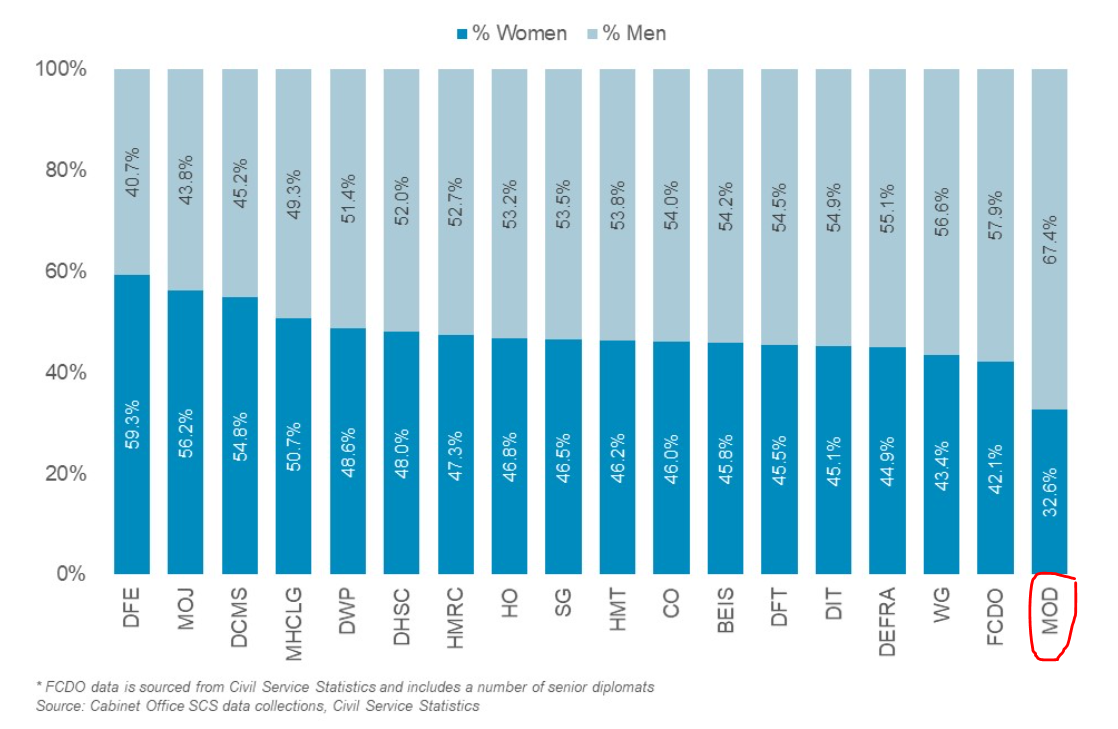
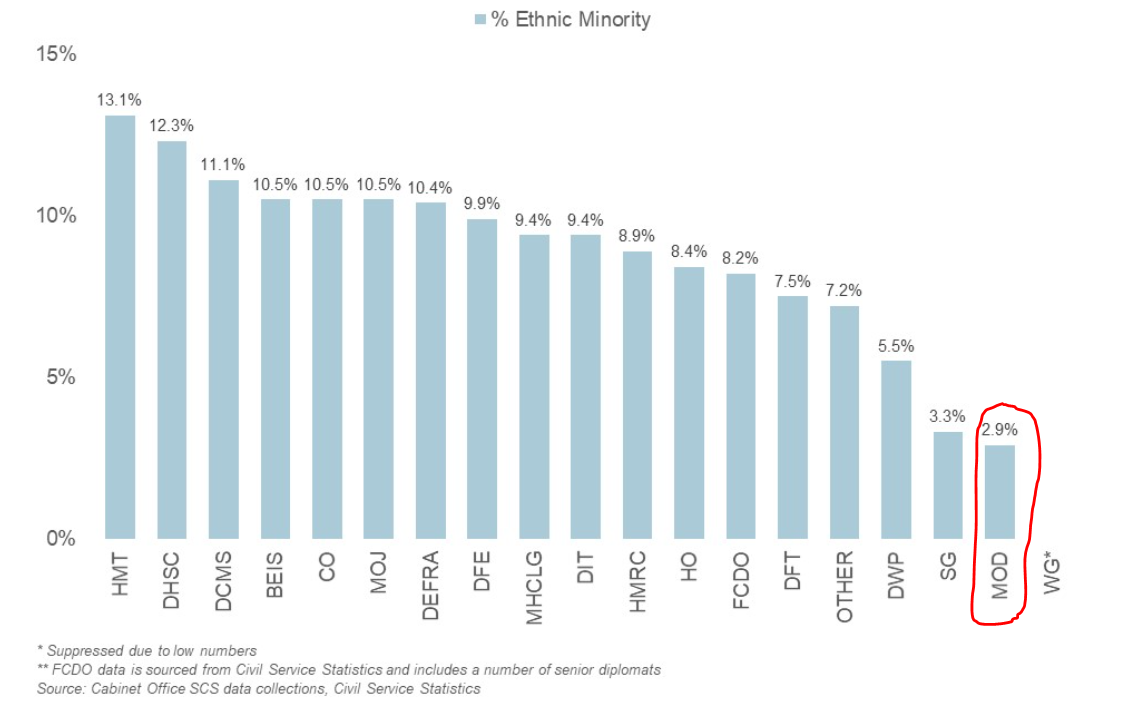
Gender diversity (left) and ethnic diversity (right) across the Civil Service, 31 March 2021.
Widespread research already proves diverse organisations outperform those who are not (McGregor-Smith, 2017, and McKinsey, 2022), with businesses performing even better when there is greater ethnic, over gender diversity (McGregor-Smith, 2017).
Combining gender and ethnicity as the two diversity challenges across Defence, this study seeks to understand organisational barriers constraining Ethnic Minority (EM) Women from progressing into SCS positions. It takes a top-down view to identify what MOD can do to increase representation over the next five years. It does this by:
-
Critically analysing the literature and theory around EM women in the workplace.
-
Analysing qualitative data to identify the unique levers and barriers experienced by different ethnic groups on their journey to the SCS.
-
Analysing quantitative data to benchmark MOD performance on D&I with other CS Departments.
-
Linking primary and secondary findings to draw out the underlining issues impacting progression of ethnic minority women.
-
Drawing conclusions to inform recommendations and measurable actions MOD could apply to increase EM women into SCS roles in line with organisational priorities.
Women represent 47.3 percent of SCS roles across the CS, and EM represent only 8.2 percent overall (GOV.UK, May 2022) which suggests the issue is wider than MOD.
Baroness McGregor-Smith (2017) finds only 10 per cent of the workforce is from an EM background with six per cent in top management positions, which is still higher than MODs 2.9 percent (GOV.UK May 2022).
CIPD (2017) forecasts ethnic minority working population to reach 20 per cent by 2030. If the variance between MODs workforce and ethnic minority working population continues to grow, Defence is at a risk of seriously underrepresenting the society it exists to serve, increasing risk to operations, by shifting its competitive edge to its adversaries.
A lack of women and the under-represented population is a significant issue for private sector organisations too. Rolls Royce Board Diversity policy (Rolls Royce, 2022) places emphasis on gender and ethnicity, stipulating at least 40 percent of its directors should be women, recognising skills and diversity requirements. It further aspires to increase percentage of underrepresented groups across the organisation with at least one EM Board member. However, no timelines are mentioned.
Deloitte have also set themselves a target to achieve 40 percent women in a partnership role by 2030 and 12 percent EM in a partnership role by 2025.
The Defence D&I plan states its aspiration to increase the percentage of female, ‘BAME’, LGB and disabled entrants to the SCS by 2030. However, it fails to define this in metrics or, how it plans to get after this. This is where this could add value.
Literature Review
Ample research suggests diverse and inclusive organisations outperform those lacking diversity (McKinsey, 2015; 2017; 2020). The return on investment is even higher on ethnic over gender diversity (McKinsey, 2022) and done rightly, could add a further 1.3 percent to UK’s GDP (McGregor-Smith, 2017).
The Equality Act 2010, Positive Action, and the Public Sector Equality Duty (GOV.UK, 2013) set the standards within which organisations must operate.
The term race and ethnicity are used interchangeably but for the purpose of this study, both encompass colour, background and cultures (Kamenou and Fearfull 2006).
In 2007, Kamenou argued minority groups were growing at a rate faster than white ethnic groups. Fast-forward to Census 2021, the Asian ethnic group saw the biggest growth across UK’s population (GOV.UK, March 2023).
Pakistani, Bangladeshi and some Black groups are particularly disadvantaged within EM groups (McGregor-Smith 2017 and Race Disparity Report, 2021). Casey (2016) reports a huge proportion of Pakistani and Bangladeshi women aren’t even engaged in employment, which is likely to impact their socio-economic status. This suggests, generalising ethnic minority groups could mask the acute disadvantages of sub-cultural groups.
Ruby McGregor-Smith, the UK’s first EM women to become CEO of a FTSE 250 company, led the government backed review of race in the workplace (2017). Whilst her own background may have proven useful, there is a risk McGregor-smith’s own bias seeped through the report. Nonetheless, McGregor-smith suggests organisational diversity targets should reflect their community which prompts further exploration into location and diversity.
Organisational structures, such as ethnic minority women in lower-level jobs (Race Disparity Report, 2021), and culture is hampering the progression of EM women (Kamenou and Fearfull 2006; Kamenou, 2007; McGregor-Smith, 2017; CIPD, 2017). Often, women of colour try to fit into an artificial white, male dominated culture (Kamenou and Fearfull, 2006). EM employees feel as though they need to change their behaviours to ‘fit in’ (CIPD, 2017) which is unhelpful.
External cultures, such as family responsibilities, which fall predominantly to women (Kamenou, 2007) create barriers for EM women. Pakistani and Bangladeshi women stand out owing to their strong family cultures (Dale 2005 cited in Kamenou, 2008). A lack of support from partners and family reduces their ‘agency’ (Kamenou, 2007), constraining progression.
However, Armstrong (2019) suggests workplace cultures impact career progression over family and outside responsibilities. Inclusive workplace cultures are fundamental to tackle diversity in the workplace, including in senior leadership. Men, as the significant representor, play a hugely influential role (Armstrong, 2019).
As such, organisations could introduce checks and balances to ease tension between family and work responsibilities (Kamenou, 2008). This could be achieved if senior leaders took the time and interest to understand cultural, social and religious differences (Kamenou and Fearfull, 2006).
Whilst women are just as ambitious as men, they are less confident about reaching top level positions (McKinsey, 2017). That said, corporate culture plays a stronger role, over mindset, to enable confidence (McKinsey, 2017). As McKinsey fails to define the scope of mid-senior management, it is difficult to map its relevance to MOD. However, workplace culture transpires as a key theme to progression.
Bias, be it unconscious (McKinsey, 2017) or unintentional (Armstrong and Ghaboos, 2019) is constraining female progression, which is displayed by women too (EY, 2019; and Armstrong and Ghaboos, 2019).
Gender bias can exist from the point of recruitment. Totaljobs found only one in five jobs advertised were gender neutral (Stem Women, 2021). Despite failures to reference original source, Stem Women display strong corporate social responsibility to support women career progression. As such, MOD SCS roles advertised on CS jobs will be reviewed for bias.
Nicolina Kamenou is one of the few academics to have researched the lived experience of EM women in the workplace. Her academic credentials position her as a credible author. However, much of Kamenou’s research has often focussed on the insights of EM women with imbalanced representation from other, white groups. The big limitations in Kamenou’s research between 2006-2008 research was a lack of UK based secondary data to draw on (Kamenou, 2008).
Discrimination is closely linked to race and ethnicity in various studies (Kamenou and Fearfull, 2006; CIPD, 2017; McGregor-Smith, 2017).
The combined impact of racism and sexism, or occupational ‘double jeopardy’ (Kamenou, 2007) constrains the career development of EM, particularly African American women. (Beal, 1970; and Perry, 1970; cited in Kamenou 2007). McKinsey (2017) argues the ‘double-burden’ effect of women as primary carers is a barrier. One cannot assume the lived experience of all EM women are the same (CIPD, 2017; Inclusive Companies). Equally they cannot be separated from other, white ethnic groups (Bhavnani 1994, cited in Kamenou 2007).
There’s been a big push on gender equality, with much success, however, women of colour remain disadvantaged (Parker Review, 2016). This is concerning considering Kamenou and Fearfull (2006) highlighted the risk around focus on gender over race almost two decades ago.
Oversight of talent, poor-quality line management, and lack of effective training and development opportunities are creating barriers to progression for EM groups (CIPD, 2017; and Race Disparities Report, 2021). Although CIPD (2017) placed line management as a separate factor, this study argues line management capability can positively, or negatively impact all the above. Senior leaders are already focussed on Diversity and Inclusion (D&I) and so less likely to lag in nudge measures (CIPD, 2019b). It’s middle managers who are likely to have less buy-in and commitment to D&I (CIPD, 2019b). Middle managers could be motivated to own the D&I agenda (CIPD, 2019b), through initiatives such as the Inclusive Leadership programme (ILP) developed by Ernest and Young (McGregor-Smith, 2017).
Women are better than their male counterparts at role modelling and developing people (McKinsey, 2017). Whilst these feminist characteristics benefit the organisation, there is a risk it impedes their own development. Karelaia, and Mayo’s (2017) interpretation of academic literature suggests women must display pro-social skills, along with self-confidence, to remain influential. In the absence of reference to original source, there is a risk of bias in Karelaia and Mayo’s statement. Nonetheless, female leaders ‘interpersonally sensitive’ approach (Rhodes, 2017), could encourage softer feedback (Barsh and Yee, 2011) making it harder for them to work with. For EM women, the double jeopardy risk of receiving soft feedback is heightened for fear of seeming racist (Rhodes, 2017) by employers which limits their own agency. This myriad of invisible barriers (Barsh and Yee, 2011) could explain why women fail to advance at the same pace as men (Barsh and Yee, 2011).
Over half the CS workforce comprises women, yet only a third is represented in the SCS, with MOD amongst the worst performers (Devanny and Haddon, 2015). Considering the report is seven years old, the data could be deemed invalid (Cameron and Price, 2009). However, according to the CS D&I Dashboard (GOV.UK, 2021) MOD remains the least representative department across the CS on both gender and ethnicity.
Aside from a statement highlighting the relatively slow progression of talented EM fast streamers, the Women in Whitehall report fails to recognise the ‘double-jeopardy’ impact on EM women.
Going back further, a survey undertaken by the CMI in 2016 (Managers.Org.UK), demonstrated the increasingly disproportionate representation of women as roles become senior. Again, it failed to consider ethnicity, which could have further reduced representation.
Armstrong (2019) suggests, perception surveys could be useful for organisations to understand the barriers impacting EM women’s progression.
In Diverse Company (cited in Race Disparities report 2021) suggests a two-pronged approach, increase representation (diversity) and shift cultures (inclusion) (CIPD, 2019a; CIPD, 2019b) which is reflected in the CS and Defence Diversity Strategy (GOV.UK, 2018; GOV.UK, 2022).
To increase representation, the CS mandates diverse panels for all SCS recruitment (MOD, 2021). However, the Race and Ethnicities Disparity report (2021) suggests further studies should be undertaken to assess the viability of diverse panels. CIPD (2022) argues organisations should avoid diverse panels as the evidence to suggest it promotes inclusive recruitment is inconclusive. Considering the freshness of this report, the findings cannot be overlooked.
Increasing representation alone will not address diversity related retention issues (CIPD, 2019?). To shift cultures, a series of ‘nudge’ measures, such as mentoring, and leadership development should also be considered (Race Disparities Report, 2021). Social capital, such as networking (Parker, 2022), sponsorships (Armstrong, 2019), involvement in wider initiatives and good quality line management can all benefit career advancement (CIPD, 2017).
Armstrong (2019) suggests sponsors and senior leaders, outside of immediate work environment, can increase access to opportunities. This aligns to the SCS Indicators of Potential (2020); ‘Is known outside of their immediate business area by building successful networks…’. Armstrong (2019) suggests, not only is sponsorship key for advancement, but a lack of it can be detrimental to progression. The level of seniority must be sufficient to support advancement. As such, any sponsorship recommendations for this study will propose minimum SCS Pay Band 2.
Most participants in Armstrong’s (2019) study agreed men enjoyed higher levels of social capital over women. The fear of being perceived as forming inappropriately close relationships with women (Rhodes, 2017, and Barsh and Yee, 2011) could explain why. This, coupled with the findings of Barsh and Yee (2011) suggests male leaders might require some form of training, coaching or other support to sponsor women across Defence.
Ghaboos own achievements, ‘Championing Gender Equality Award’ (2018), adds weight to his finding.
The Race Disparities Report (2021) suggests organisational redesign and training could shift cultures (Race Disparities Report, 2021). Organisational structures or redesign includes roles, i.e., representation of those in positions of power, and level of development roles creating opportunities (Kesler, 2020). It considers location and its role in drawing diverse talent (Kesler, 2020). More fundamentally, it’s about where accountability for diversity sits within the organisation, and whether it’s in siloed network groups and diversity teams or built into the fabric of the organisation (Kesler, 2020). Kesler was acquired by Accenture, a global organisational with over c700K employees worldwide, in 2020 to drive their organisational redesign work.
Moving onto training, Musa al-Gharbi (2020) argues beyond presentation and legal obligations, diversity training has no impact on workplace cultures, and could in fact be counterintuitive (Dobbin and Kalev, 2016). Organisations should instead focus on providing a platform for open and frank conversations to take place around differences (Musa al-Gharbi, 2020). This comes across as quite a natural statement from a sociologist and likely to reflect early observations of al-Gharbi’s research ahead of his forthcoming book, inequality, social justice and discrimination.
Most organisation continue to employ outdated diversity initiatives which fail to work (Dobbins and Kalev, 2016). This could be the result of organisations overly focussing on process over outcome (Race Disparities Report, 2021). A clear example for the CS is the mandatory requirement to complete unconscious bias training (process), yet this has not markedly changed representation or cultures (outcome). There is a risk of disengaging people through forced action (Musa al-Gharbi, 2020). Ultimately, if instead, middle managers are engaged, and exposed to women and EM groups, increasing their confidence to engage and promote social accountability (Dobbins and Kalev, 2016), employers are far more likely to increase buy-in (CIPD, 2019b) and shift cultures.
Mitie Group PLC, Government Commercial Organisation, and Rolls Royce were amongst the UKs top 30 Inclusive Employers for 2022/23 (Inclusive Companies). As large-scale global organisations, their D&I measures could usefully inform the Defence D&I agenda.
Rolls Royce (RR) stands out as a Defence Partner. RR has a strategy to attract students from diverse backgrounds with a clear focus on women and ethnically diverse backgrounds (ise, 2021). They are doing this through outcome-focussed outreach, capitalising on ‘digital engagement’, such as social media. This is supporting students with direct access to RR role models and leaders. Recognising social mobility and other disadvantages EM groups face, RR removed degree requirements and online tests from their recruitment and selection process (ise, 2021). However, RR do not fully publish their diversity data, so it is difficult to track progress. From what is published, it is evident, like MOD, RR have a huge issue with female representation in senior leadership. Given its strong links to Defence, and global workforce of 44K, there is huge advantage in tracking RR diversity initiatives and exploiting joint partnerships with Defence on D&I.
Elsewhere, Parker Review (2022) and Hampton-Alexander Review (2021) mark significant pieces of government backed work to increase ethnic diversity in Boardrooms. Next, and Glaxo-Smith Kline (GSK) were amongst the top performers (Hampton-Alexander Review, 2021). Considering Next (c44K) and GSK (c90K) workforce is representative of MOD, their initiatives could usefully inform the recommendations of this study also. Sir John Parker’s own portfolio (GOV.UK), adds weight to wider recommendations.
In Diverse Company developed a Cultural Inclusion Maturity Model (CIMM) to measure inclusion in the workplace. MOD could test how inclusive the organisation is across select departments using a similar tool to help inform the right interventions. Success could then be measured through the People Survey 2024 results.
Baroness McGregor-Smith has been saying since 2017 the time to talk is over and action must be taken. Progress is frustratingly slow (CIPD, 2021) which impedes EM women even more (Armstrong and Ghaboos, 2019).
By focussing just on gender, women of colour were overlooked (Parker Review, 2016). By focussing just on ethnicity, there is a risk, socio-economic differences (Race Disparities Report, 2021) could impede others.
Kamenou (2007) argues not all EM women will share the same lived experience and so not all barriers and levers will apply equally. However, the combined effects of race and gender in the workplace remains an under-researched area (Kamenou and Fearfull, 2006) and so it is difficult to apply evidence-based levers. Jumping to solutions before doing the research risks wasting resources, and damaging stakeholder relationships, ultimately failing to deliver value for money (CIPD, 2019b).
Kamenou has been calling for greater breakdown and analysis of the lived experiences of different ethnic groups to inform policy and processes since 2008. Yet, there is a continued focus on ‘surface-level’ diversity at the expense of deeper-level analysis (CIPD, 2019a)
The CS D&I dashboard does not breakdown EM analysis to reflect subcultural representation. Data declaration is key to understand the extent to which EM groups are under-represented (CIPD, 2021). To achieve this, organisations must demonstrate transparency around data use and show positive change (CIPD, 2021).
The Race Disparities report (2021) argues interventions should be based on need rather than ethnicity. This suggests its more about inclusion over diversity, albeit there is still a degree of uncertainty around what inclusion really means (CIPD, 2019a). The Race Disparities Report (2021) suggests inclusion is providing everyone equal opportunities to succeed and avoid interventions which segregate ethnic groups. This is an interesting point which conflicts several case-studies highlighted in the McGregor-smith review (2017) whereby organisations adopted EM specific interventions.
Before considering interventions, understanding the organisational context is key (CIPD, 2019b). The Defence D&I Strategy reflects the Whole Force Military and Civil Service workforce (GOV.UK, 2018), but only reflects the broader issues, challenges, and opportunities (CIPD, 2019b) owing to the sheer size and multiplicity of issues across the business.
Sadly, Defence continues to remain the least representative department across the CS, since at least 2015 (Devanny and Haddon, 2015). This suggests the measures and interventions are failing to have the desired effect. This could be the result of overreliance on recruitment over shifting culture, focussing on process over outcome, suboptimal organisational structures, a lack of data informing good choices, as well as a myriad of invisible barriers impacting the lived experience of EM groups. It is pertinent to mention, any interventions or positive action must be carefully managed to avoid crossing over to positive discrimination (Robertson, 2017).
The Defence D&I Plan (2018-2030) sets out c24 actions under three goals, however, they remain highly opaque. For example, ‘Goal 2’ states MODs ambition to increase percentage of ‘female’ and ‘BAME’ representation in SCS which is hugely welcome news but doesn’t describe how.
CIPD (2019) suggests effective D&I strategies will take into account local level issues, challenges and opportunities which is unclear in the Defence D&I Plan.
The role of staff networks is also mentioned in abroad, fluid sense. The role of leaders is highlighted; however, the role of middle and line managers is a missed opportunity who may not necessarily view themselves as a leader.
Drawing on secondary findings, this study will explore culture, leadership, organisation structures, and the lived experience of the MOD workforce across a range of backgrounds to identify the double jeopardy barriers constraining EM women progression into the SCS.
Research Methodology
Saunders research onion (Tengli, 2020) was applied to the research methodology.
Philosophy
To understand organisational barriers constraining EM women from progressing into MOD SCS roles, both sides of the epistemology philosophy (Cameron and Price, 2009) were applied. The positivist framework broadened understanding of the issue (Cameron and Price, 2009), whilst the interpretivism philosophy uncovered its impact on Defence and its people (Cameron and Price, 2009).
Constantly changing and evolving perceptions (Taylor and Bogdan, 1998, p3 sited in Heath and Tynan, 2010) around work and career, isn’t always captured through the positivist framework. This is where the interpretivism viewpoint can complement the research (Bryman, 2004 sited in Heath and Tynan, 2010).
The gaps in secondary research relating to EM women in the workplace (Kamenou and Fearfull, 2006), meant this study took an exploratory view, placing qualitative findings and interpretivist methodology at the heart of this study.
Research Approach
Secondary research suggested gender and ethnicity imbalance in senior leadership. The positivist framework validated this, deducing (Cameron and Price, 2009) organisational barriers into key themes for this study.
The interpretivist philosophy, using an inductive approach (Deshpande, 1983; Bryman, 2004 sited in Heath and Tynan, 2010 and Cameron and Price, 2009) built the impact and lived experience bottom-up.
Strategies, Choices and Time Horizon
Owing to time and resource limitations, this study focussed on MOD, discounting the case-study approach (Cameron and Price, 2009). It took a top-down and bottom-up approach, using a mix of action research (Cameron and Price, 2009) and grounded theory (Cameron and Price, 2009).
A mixed method approach mitigated some limitations associated with specific research methods (Cameron and Price, 2009). Whilst quantitative analysis suggested there was a problem, qualitative analysis reinforced findings, highlighting why there was a problem. A cross-sectional research method (Rindfleisch et al, 2008) was applied to meet set timelines.
Data Collection
Quantitative primary research
Ethnicity by grade was requested from Defence Business Services (DBS) through internal processes for 31 March 2022. This provided a generalist view of the future internal EM SCS pipeline. This was reliable data, considering MyHR, a self-service HR tool, will provide the same result for that day every time (Cameron and Price, 2009). This data was slightly out of date (Cameron and Price, 2009), however, to enable triangulation (Cameron and Price, 2009), it was necessary to gather and analyse data over the same time-period. Other limitations to this method included gapped data because it was disclosive and removed by DBS, or lacked a declaration altogether. This constrained the true levels of diversity. However, this was a cost-effective method (Cameron and Price, 2009), with time of the HEO to extract this data.
Quantitative secondary research
Gender representation by grade was published data (GOV.UK, Jul 2021). Drawing on data at 31 Mar 2022, the future MOD SCS gender pipeline was analysed. Readily available, this was even faster and cheaper to collect. This data was also highly reliable and credible considering CS Statistics undergo four rounds of quality checks before publishing (GOV.UK, Jul 2022).
Whilst there is a risk with secondary data meeting the direct aims of this study (Cameron and Price, 2009), Official Statistics enabled MOD benchmarking against other CS departments, supporting objective three of this study. CS Statistical data (GOV.UK, Jul 2021) provided SCS headcount data for all CS departments. This was overlaid with CS Diversity and Inclusion data (GOV.UK, May 2022), converting percentage diversity into FTE to find the rate of gender and ethnic diversity per 100 SCS headcount.
Whilst the preference was always to use up to date and valid data (Cameron and Price, 2009), the study analysed 2021 data for SCS headcount over 2022. This was following its dependency on diversity data to find gender and EM rate per 100 SCS posts, which was only available for 2021. The results supported the action research approach whereby contact with departments reflecting a better EM rate per 100 SCS posts was made whilst the study was still ongoing to explore new initiatives MOD could adopt.
CS Statistical data (GOV.UK, Jul 2021) provided workforce numbers by regions for CS departments. This was helpfully overlaid with Census 2021 regional ethnic diversity data (GOV.UK, Dec 2022) to compare organisational diversity across the UK region it sits in. Considering both CS Statistics and Office for National Statistics (ONS) apply rigour to data ahead of publishing, this is highly reliable and credible data.
MOD People Survey 2021 data was analysed (GOV.UK, Apr 2022), focusing on inclusion and fair treatment as well as bullying and harassment by gender and ethnicity following its relevance to this study. This data suggested there was an issue, providing no further insights. It did, however, navigate primary qualitative research to explore the issues further.
Some discrepancies were found between MOD and Cabinet Office published data. MOD published data (GOV.UK, Sept 2022) for 1 April 2022 reflected an overall headcount of 59,900 Full-Time Equivalent (FTE). According to Cabinet Office (GOV.UK, Mar 2023), MOD FTE over the same period was 57,830. The variance is small and unlikely to skew gender and EM data but highlights the limitations (Cameron and Price, 2009) in all data.
Qualitative primary research
Semi-structured interviews were conducted, with eight SCS women from EM background, five SCS women from white background and an undisclosed number of white men and non SCS EM women. Data presented by DBS, at 31 March 2022, shows 25 MOD SCS declared themselves as EM. Assuming women represented a third of that cohort (GOV.UK, May 2022) would suggest approx. six EM women are in MOD SCS roles. Considering this study identified at least eight, suggests the findings are massively representative. It also suggests representation might be a bigger issue for EM SCS men.
EM SCS volunteers were sought through the SCS Management Team, sparking broader interest from SCS white men and women, all of whom were interviewed. 30-minute interviews were conducted virtually through Microsoft Teams, using pre-defined semi-structured questions (Cameron and Price, 2009) to identify barriers and levers to progression. This was a cost-effective and environmentally friendly approach, mitigating location barriers. Because the numbers were small, the flexibility of interviewing enabled deeper probing to clarify understanding (Cameron and Price, 2009). Focus groups were considered as a quicker way to gather deep insights (Cameron and Price, 2009). However, this could have been a complex social and hierarchical dimension (Cameron and Price, 2009) for a G7 to facilitate and coordinate. Considering sensitive and personal insights were shared, interviews were the better option.
Interviews were held in Feb 23 and so valid. It was led by an EM woman, enabling relatability and open and honest conversations. However, if this was undertaken again, by a white male for example, it could deliver a different response which reduces its reliability.
Blind spots (Syed, 2020) were covered by adopting an unstructured approach, stating only the research aim and objectives, when engaging wider stakeholders (Cameron and Price, 2009), such as Network champions. This followed the grounded theory approach, where some stakeholders, such as Jason Ghaboos and Paul Lincoln were interviewed for their observations prior to undertaking the literature review. Virtual interviews were quick to organise, saving time and cost, thereby securing maximum attendance.
Whilst this study intended to run a perception survey (Armstrong and Ghaboos, 2019) to capture perceived barriers by MODs delegated grades, it was unable to identify an Information Asset Owner (IAO) to sign off the data collection. This could have added a new dimension to the findings.
Qualitative secondary research
Content analysis of MOD SCS job advertised was undertaken between Dec 22 and Feb 23. This was achieved through Textio, an Artificial Intelligence software.
Textio reviewed job adverts for signs of social bias (Cameron and Price, 2009). This was a cost-effective approach, considering MOD have procured the license, thereby increased its return on investment. The flexibility and freedoms with this approach meant activity could be stopped if no utility was found. Textio is used by some of the most high-profile organisations globally, for example, Starbucks, Google, Amazon and Bank of America. This adds to its credibility. If the same job advert was run again through Textio, it would return the same results, proving its reliability (Cameron and Price, 2009).
Academic research and journal articles provided a strong argument for the hardships women face to progression. This guided the research, informed interview questions and added richness to conversations with stakeholders. The big limitation was focussed research on EM women, which meant some of the results and conclusions drawn in wider literature are not directly relevant to this study (Cameron and Price, 2009).
The organisational context and settings within which secondary research was conducted varied, and so again wasn’t always relevant (Cameron and Price, 2009). It did, however, find some themes prevalent across different research, which was reinforced through this study. This research went on to plug gaps in secondary research, identifying critical organisational barriers impacting ethnic minority women specifically.
The positivist framework and interpretivist approach complemented each other. Quantitative research offered instant access and flexibility to large scale data gathering (Cameron and Price, 2009), which found there was a problem. Qualitative analysis validated quantitative findings, whilst identifying other, invisible barriers. It also suggested why there was a problem, highlighting the impact on Defence and its people.
Access, ethical and resource implications
Cultural, social and age-related barriers, of the researcher presented no hierarchical or other invisible barriers (Kamenou, 2007) to the research.
Access to MOD data was granted by DBS.
Participant anonymity was maintained to protect personal views and sensitive information. All identifiable data was removed from this study. Government handling guidelines (GOV.UK, 2018) where adhered to, storing all ‘OFFICIAL SENSITIVE PERSONAL’ data on MOD assets and labelled OSP.
Named quotes were cleared with participants before using. Only questions relevant to the research (Cameron and Price, 2009) were collected. Special category data such as gender and ethnicity were relevant. Marital status, age, and sexual preference were not sought, saving time (Cameron and Price, 2009) for other analysis.
Research Findings, Analysis & Discussion
The research found organisational structures, language, culture and leadership had the greatest impact on career progression of EM Women into MOD SCS positions. Whilst quantitative analysis pointed to organisational structures and language, culture and leadership were key aspects of qualitative findings.
There were some synergies, and mixed impressions, from women in Defence around their journey into the SCS, validating wider literature (CIPD, 2017; Inclusive Companies; and Bhavnani 1994, cited in Kamenou 2007).
Organisational structures
SCS Pipeline
MODs gender representation at all levels is positive, reflecting an adequate pool of diverse talent for future SCS roles.
However, the internal SCS EM pipeline is small. This is concerning as qualitative findings suggest circa 70 percent of MOD SCS job applicants are internal candidates. Other qualitative findings also suggested EM candidates for MOD SCS jobs were not coming through. This finds organisational structures are not optimally configured to deliver improvements in SCS diversity.
The data also confirms true levels of ethnicity across MOD is unknown. Total undisclosed data is greater than those declaring EM. If majority of those failing to make a declaration or actively choosing not to make a declaration are EM, this would suggest the actual EM representation is three times more than perceived. According to CIPD, 2021 (Race Inclusion Report), those refraining from declaring ethnicity do so because they don’t trust it will lead to positive change. This suggests MOD should actively communicate its diversity related initiatives to improve declaration rates.
It’s unhelpful to aggregate ethnic diversity data into one category. This masks variations in the lived experience of sub-cultural groups (Race Disparity Report, 2021). Instead, it should aim to disaggregate where possible. Owing to the small representation across Defence, it may not yet be possible to publish this level of granular data.
This data could be disaggregated further, uncovering the rate of Indian, Pakistani, and Bangladeshi within Asian groups (GOV.UK, List of ethnic groups). However, it was too disclosive to break this down further for this study which reinforces just how small the EM population is for a workforce of nearly 60,000. Aggregating sub-cultural groups into one category risks organisations pursuing interventions based on the assumption all EM groups share the same lived experience, which this not true.
What’s the impact of small EM representation on its current workforce? One SCS EM woman, whose overall lived experience of Defence was positive, said, **“Not many ethnic minority seniors, so you look and sound unusual. Other people won’t be used to it. It’s a new experience for them so they are acting hard to overcome bias”, and went on to further say, “People have difficulty being challenged by someone of different ethnicity”. This reinforces the need to increase representation at all levels, not least to increase representation but shift cultures and improve the lived experience of both white and EM colleagues.
SCS Headcount and Diversity
One EM SCS woman said, “There aren’t many opportunities at SCS, so people leave for other government departments or private sector.” This was reinforced by a member of HR Directorate suggesting the MOD SCS footprint was smaller than other departments, resulting in less churn and opportunities, thereby, less diversity. This was tested using a Chi Square test (Cameron and Price, 2009) to confirm if there was indeed a relationship between SCS headcount and rate of gender and ethnicity. On both accounts the Chi Square test rejected the null hypothesis suggesting there is no relationship between SCS headcount and gender or ethnicity. The observation/hypothesis was drawn from a senior MOD official. Non-parametric tests are not the most powerful tests (Cameron and Price, 2009), so a spearman rank correlation coefficient test was applied to validate the findings. The results of the second test suggested a very weak positive correlation, confirmed by Fig 4 and 5 below which reflects very little association between the two variables.
Whilst it may seem, CS departments with greater SCS footprint results in higher rate of diversity, Ministry of Justice (MoJ) reflects a higher rate of diversity even though their SCS footprint was smaller than MOD. Quantitative analysis rejected the qualitative findings, and so increasing SCS headcount may not necessarily deliver the return on investment.
Regional analysis
Another EM woman said they “Created own barriers, location being one of them as from [location X], and with small children, didn’t think could travel. Limited myself”. This statement reflects a myriad of barriers which include location, family responsibilities and mindset, linking to the ‘double-burden’ effect (McKinsey, 2017). One could argue, the term is not a true reflection of the myriad of responsibilities resting with women and so, this could be termed the ‘multi-burden’ effect.
Nonetheless, one EM SCS woman said location barriers delayed their progression. To test this, Census 2021 ethnicity by region data was overlaid with MOD workforce by region data. A similar exercise was carried out for the other, big four, CS departments. The analysis found MODs workforce was located predominantly in the South-West, followed by South-East (GOV.UK). According to Census 2021, EM population is highest in London, and higher in the Midlands. It is lowest in the South-West and South-East.
Oher departments like MOJ, and Her Majesty Revenue and Customs (HMRC) are located predominantly in London and the North-West which benefits from an ethnically diverse labour market. This suggests MOD is not located in the most racially diverse parts of the region and so organisational structures, i.e., geographic locations, is constraining the progression of EM women, particularly those impacted by the ‘multi-burden’ effect and Bangladeshi, Pakistani and Black Caribbean women who reflect the smallest footprint in South-West and South-East England. Defence could explore location flexibility for SCS roles. Or, as Paul Lincoln, previous Director General for Border Force and Gender Champion for Home Office did when recruiting 2,000 people in Dover, undertake the modelling to explain the impact of location on diversity to settle on a tolerable, acceptable position for the organisation.
However, as it stands, MODs internal and external pool of EM SCS candidates is small and explains why their applications are not coming through.
Language
MOD SCS jobs posted on CS jobs failed to meet the standard inclusive and effective language criteria according to Textio, an Artificial Intelligence tool. This suggests social bias is prevalent in the MOD recruitment system. Content analysis found mixed gender tones in adverts which tended to be overly masculine on job specifications, using words like managing, proven and essential. However, when reviewing the broader narrative, such as benefits, D&I statement and other house-keeping information, the tone mellowed out to a more neutral style. The danger of problematic and harmful words, such as stakeholders and maternity was rife.
Most MOD SCS job advertised between Dec 22- Feb 23 were too long. LinkedIn research suggests women are 16 percent less likely to apply for a job owing to loss of confidence when presented with heavy job requirement, and self-doubt in meeting the entire essential criteria (Werber, 2019). A white ethnic SCS woman during interview said, “Women look at job specs and requirements are too onerous, and women are more likely to hit crisis of confidence looking at job adverts.”
Lengthy job adverts are giving women the time to reconsider their job prospects, internalising reasons they wouldn’t be a good fit. Linking back to the ‘double-syndrome effect’ women are also more likely to be ‘time poor’, thereby considering smarter recruitment options would remove some of the barrier’s women face. With the added conundrum of masculine terminology, women are less likely to relate to the job. This hasn’t even looked at the impact on EM women which could be further exacerbating the issue.
All Defence departments advertising SCS jobs between Dec 22-Feb 23 failed to reach the average score of 70. There are variations in scores by department. To test whether there was a relationship between the language used and Defence department, a Chi-Square test was applied, grouping Defence departments into three categories, Front-Line Commands (FLC), Non-FLC Military enabling organisations, and civilian departments. The results rejected the null hypothesis, suggesting there may be a relationship between the language in an SCS job advertised and Defence department. This doesn’t tell us the nature of this relationship. For example, is there a positive or negative relationship between language and FLCs. One could assume the language of FLCs, as highly militarised organisations, contain a higher degree of military bias, reflecting its white male culture. The high accumulation of lower scores by civilian departments owing to their larger workforce requirement, could skew the data. It is difficult to interpret the findings in a meaningful way. To understand if this was an issue across delegated grades, the same analysis was undertaken for HEO jobs posted between Jan 23 – Feb 23.
Immediate observations suggest MOD job language in the lower grades is far more balanced and inclusive. A Chi-Square test was applied again to assess whether there is a relationship between department and language. MOD departments were grouped into the same three categories. The results again suggested a relationship between department and language. On this occasion, the workforce requirement was greater in FLCs and military organisations. As such, there was a higher accumulation of Textio scores for FLCs over civilian departments which didn’t necessarily suggest the language was more inclusive. There are huge limitation in the Chi-Square test. It goes so far as suggesting there is a relationship between job language and Defence department but does nothing beyond to explain the nature of that relationship.
Nonetheless, the language of MOD SCS jobs advertised is poor. The use of masculine words takes away relatability of the role for women. The overly detailed job descriptions is giving women time to re-consider their employment options. This is creating barriers to progression for EM women who are now less likely to apply.
Diversity Statements
Job adverts are a prime vehicle for MOD to reflect its approach and commitment to diversity (Brew, 2020). This can be a quick win to influence under-represented groups to consider joining the MOD SCS Team. The below is what most Defence departments include in their SCS Job adverts:
The Civil Service embraces diversity and promotes equal opportunities. As such, we run a Disability Confident Scheme (DCS) for candidates with disabilities who meet the minimum selection criteria.
According to Brew (2020) a good diversity statement will be between 20-75 words, lose the term ‘diversity statement’, include short sentences and contain words such as commitment, freedom, inclusion, belonging and growth. In comparison, the above is a poor statement which shows a lack of inclusion for other protected characteristics, such as gender and ethnicity. There was the additional missed opportunity to reflect Defence’s own D&I ambitions and aspirations. The above statement was discussed with the Cabinet Office (CO) D&I Team who suggested departments are expected to own their D&I agenda and reflect this in line with their own organisational context.
It would be unfair not to recognise some of the exemplar diversity statements Defence departments include in their job adverts. Submarine Delivery Agency (SDA) stand out for their statement:
We champion a diverse and inclusive environment, where everyone can be themselves and give their best. We believe that by harnessing the power of different ideas, experiences, and perspectives, we can achieve our ambitions, together. If you have a disability or additional need that requires accommodation, please let us know.
This utilises more words than MOD average, includes punchy terminology like ‘champion’ and ‘harnessing the power of different ideas’, and accommodates wider needs. What is unclear, and potentially missing from the current governance structure, is who is holding the pen on this to say this is an exemplary statement?
Diversity statements belonging to the top-ranking Inclusive Companies organisation 2022-23 were gathered during the course of this study to usefully inform MODs refreshed diversity statement to increase its appeal to diverse candidates.
Culture
Culture was a key theme in the lived experience of both white and EM women. Primary research found both white and EM women experienced bias in the workplace. This was evidenced when a white SCS woman shared their experience of being “Ushered to the back of the room” during meetings. An EM SCS women said, “Military men will bypass me and go straight to my LM who will then direct them back to me”. According to Armstrong and Ghaboos (2019), bias, be it unintentional or unconscious constrains progression. This could easily knock confidence and cause women to, “second guessing yourself”.
It was difficult to determine whether any bias EM women experienced was gender or racially driven, or both (Kamenou, 2007). However, considering the sheer volume of comments made by EM women in interview (see appendix xx) suggests racial bias is more prevalent than gender bias across Defence.
There was a general impression from EM women that, “The organisation is good at talking about it but not doing” when it comes to diversity. Another EM SCS woman validated this by saying, “The culture and practices doesn’t show we value diversity” suggesting*,* “Our highly classified systems constrain groups of people”. This aligns to a statement made by Paul Lincoln, previous Gender Champion for the Home Office, who said “A diversity issue is a business issue, but it’s not taken that way”. This reinforces the need to take a top-down organisational approach.
One white SCS woman made a key point, suggesting “You need critical mass to bring cultural change”. Gender balance is potentially the critical mass stamping out gender bias. There is no critical mass when it comes to ethnicity. This could explain why the MOD People Survey 2021, found a disproportionately high percentage of EM groups reporting bullying and harassment (GOV.UK, 2022). If culture is hampering the lived experience of SCS EM women, it could be equally impacting EM women in the delegated grades more so. One example of this comes from an EM woman in the delegated grades who said, “People are surprised when they see me for the first time. Lots of bias in my name, people think im a man from my name and surprised when they see a woman. I wear a headscarf and that too surprises people when they see me. I think others don’t know how to interact if you’re the first Muslim person they are coming across”. Another SCS EM woman said, “Having to work so much harder than my male counterparts and white male counterparts more so. People don’t take you seriously, in meetings they don’t think you could add substance and then when you do, they don’t value it”, further adding, “Proving your worth is hard and exhausting”. One could argue bias is widespread across Defence, evident from EM women in different parts of the organisation citing the same lived experience. Culture is constraining the lived experience, confidence, and ultimately choices around progression within Defence.
Defence does, however, recognise it has a problem. Whilst the majority Defence workforce serves with dignity, and integrity, and role model the highest standards, there are some who fail to reflect such values in their behaviour (Wigston Review, 2019). The review, whilst focused on the Armed Forces, has massive implications upon the civilian workforce working alongside Military colleagues. Defence continues to address the recommendations from the review which reflects its commitment to improving the culture. However, most of the recommendations were overly focussed on diversity and training interventions, which according to Musa Al Gharbi (2020) is not the most effective way to address these challenges. The one year on review by Gray (2020) expands this, placing a balanced emphasis on targets, resource, funding and feedback to strengthen the agenda for unacceptable behaviours.
This study finds organisational structures and culture are highly dependent upon each other. It supports In-Diverse Company’s (cited in Race Disparities report 2021) view of a two-pronged approach, increase representation, by fixing organisational structures, and shift culture, through ‘critical mass’ to improve diversity (see the model below).
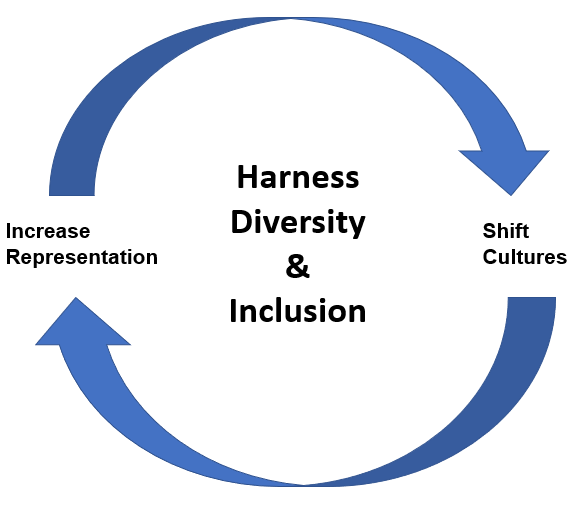
A model to improve diversity (Inclusive Companies)
Leadership
One EM SCS woman said they were told following an interview, they were “not the right fit”. What do you do with that? Feedback one cannot work with delayed the progression of this EM individual. Recognising this statement and wider literature on ‘softer feedback’ (Barsh and Yee, 2011) disadvantaging EM women, this study approached senior leaders from white ethnic background to capture their views.
One white SCS woman said ***“*Sometimes I feel indefensible, I don’t know what the right language is. I am afraid of offending someone if I called them ‘Black’ for example”. This finding was reinforced by another senior white male leader who said, “There is a minor paranoia in engaging this matter and discussing ethnicity issues of saying the wrong things at the wrong time”. These are powerful findings which could unintentionally lead to unconstructive feedback for fear of seeming racist (Rhodes, 2017) or ‘offending someone’. Whilst it is clearly not the intention of senior leaders, this does risk the career advancement of EM women.
Senior leaders across Defence are committed to the diversity agenda (CIPD, 2019). This was evident in this study when, despite a calling notice to interview women and EM in SCS, senior white men also came forward to offer their support. This reinforces the findings of the Wigston Review (2019) in that Defence recognises it has a problem and is committed to improving. Senior leaders are instilling within EM women sitting on recruitment boards as diverse panels, their views and opinions count, and this isn’t a ‘tick box’ exercise. On one interview, the CS Commissioner treated an EM woman like she was the admin person and asked if she was taking notes. MOD senior leaders corrected this misunderstanding, explaining she was the independent panel member and part of their leadership team. This demonstrates the wider issue with bias, beyond Defence.
Leadership is key and can be both a barrier and lever (Armstrong, 2019) to progression. Defence should instil within senior leaders, particularly white men, the significant role they play as the major influencer (Armstrong, 2019). Sir Alan Massey KCB CBE, former 2nd Royal Navy Sea Lord knew this and “went out of his way to mentor new members to the dept. He wanted to help different kinds of people”.
One SCS EM said, “Lots of senior leaders around here who could come up to me and ask me what my barriers are. Talking to people can help. Just ask! It’s on individuals to put themselves out there, have the conversations, network”.
Levers
One trait prevalent amongst all women interviewed was their resilience. They all described themselves as ‘thick-skinned’. This suggests MOD could support more women, and EM women, to progress by focusing on building their resilience, and preparing them early for future leadership.
MOD has access to some of the best learning and development opportunities, such as Fast-Stream (FS), Future Leaders Scheme (FLS), and Positive Action Pathway (PAP) which could be hugely beneficial for resilience. A white SCS woman confirmed “The MOD FS programme was great”. Another said, “The fast stream really instils within you that your potential is SCS, and your goal is to fulfil that potential. Your calibrated into that which gives you a real boost”. A third white SCS woman said “Did FLS it was fantastic. Helps you think about leadership in different ways”.
Whilst this was a positive finding, it only supports the progression of white women. Most EM SCS women interviewed stated they missed the mark for FLS and were instead offered High Development Leadership Programme (HDLP). Does this suggest there is bias in FLS? An article published by the Harvard Business School suggests testing candidates hurts women and EM groups especially (Dobbin and Kalev, 2016) yet the CS continues to employ outdated initiatives (Dobbin and Kalev, 2016), constraining the progression of EM women.
It is accepted MOD has little sway over the FLS programme. However, based on its successful conversion rate to SCS, MOD could consider an in-house SCS leadership development programme for EM candidates at G6-7 to instil their confidence and resilience, whilst demonstrating its commitment to increasing EM women into senior leadership. One could argue PAP is designed to support this, however, only one SCS woman interviewed undertook PAP which reflects a weak relationship between PAP and senior leadership.
Social capital (Ghaboos, 2019) transpired as a key enabler to progression. One SCS woman said, “I had the best line manager who was a Brigadier who said to me others would have to beat you to be successful…. My LM instilled every bit of confidence in me”. Most SCS participants, as members of FLS or HDLP, were offered mentors which was hugely beneficial. One mentioned benefitting from a hidden sponsor. Networking transpired as a positive lever, where one participant stated, “Networked helped hugely, did it myself. Watched consultants and learnt and now network all the time”. Could Defence look at how it engages professional services in a novel way, optimising skills transfer for its G6-G7 cohort?
There was broad consensus from qualitative findings that Defence is ‘good at talking about diversity’ but this doesn’t translate into anything. It found good will and intent, but individuals ‘slip back to people we are comfortable with’. Those who did reach SCS did so because they were determined. It took a bottom-up approach to increase diversity. They managed their own careers, sought networking opportunities, built their resilience, and applied for FLS. This study finds, Defence needs to equally take a top-down approach to accelerate the progression of EM women into the SCS. To do this, organisational structures, the language, culture and leadership must be configured to enable, not disable progression.
The pace of change
McGregor-Smith (2017) has repeatedly said, progress is slow (See Table 1 below), and predicts the UK EM population to reach 20 per cent by 2030. Considering its already at 18.3 percent, and assuming it continues to grow at the same rate every year, this study predicts UK EM population will be around 25 percent by 2030.
| 2018 | 2022 | 2030 | |
|---|---|---|---|
| UK Ethnic Minority Population | 14.4% | 18.3% | 25%* |
| MOD Ethnic Minority Population | 4.7% | 6% | 8.6%* |
| Variance | 9.7% | 12.3% | 16.4% |
This means the variance between MOD workforce and the society it serves will only grow if radical shifts are not made now.
The c24 action Defence D&I Plan (2018-2030) is opaque. It highlights MODs ambition to increase percentage of ‘female’ and ‘BAME’ representation in SCS but doesn’t describe how. Whilst Jason Ghaboos, G6 Civil Service Diversity and Inclusion and author of ‘Everyday Workplace Inclusion’, speaks highly of Defence, this reinforces his comment, “Defence have the ‘what’ they are grappling with the ‘how’”.
Conclusions
The Defence Command Plan recognises it must become a more diverse and inclusive organisation to ‘safeguard the security, stability and prosperity of our nation’. However, Defence remains the least representative department for SCS for gender and ethnic minorities (GOV.UK, 2021).
This research reviewed organisational barriers impacting EM women from progressing into SCS roles. It critically analysed literature and theory around EM women in the workplace, analysed qualitative data to understand barriers and levers impacting the progression of EM women across Defence, analysed quantitative data to benchmark MOD D&I performance against other CS departments, and linked primary and secondary findings drawing out critical organisational barriers to inform recommendations to increase representation across the SCS.
The literature highlighted a myriad of barriers impacting EM women’s progression in the workplace. A top-down view of this study found organisational structures, culture, leadership, and language as critical barriers to progression.
Organisational Structures
Early hypothesis suggested a smaller MOD SCS footprint impacted representation. A Chi Square analysis rejected this hypothesis suggesting there is no relationship between SCS headcount and levels of diversity. A spearman rank correlation coefficient returned a similar, weak positive, result.
Location could impact diversity. Drawing on census 2021, regional analysis confirmed EM population in the South-East and South-West was low, where MOD workforce was most concentrated. This finds MOD is not geographically structured to draw a diverse talent pool, backed by qualitative findings where one SCS EM women said location was a barrier to progression.
Further quantitative analysis confirmed the internal EM SCS pipeline was too small. To add, c70 percent of candidates for MOD SCS jobs are internal applicants, suggesting this is a vicious circle. There are some limitations to this finding, with undisclosed ethnicity information constraining the true levels of diversity. However, qualitative analysis found the EM workforce is unfamiliar, owing to the small representation. This concludes the internal and external pool of EM SCS candidates is constraining MOD SCS diversity.
Language
The language and length of SCS job adverts is poor which means women are less likely to apply (Werber, 2016). SCS Job specifications were fraught with masculine words. Women are likely to see this and hit crisis of confidence. Defence has lost its EM women leaders before they apply. MODs diversity statements could be improved to attract more diverse leaders.
Culture
The ‘occupational double jeopardy’ effect of sexism and racism was widespread, not only in secondary literature, but in the primary findings of this report and other secondary findings such as the MOD People Survey 2021 and Wigston Review (2019). MOD acknowledges it has a problem and is addressing this through internal holding to account. The solutions are however, focussed on training, which Musa al Gharbi (2020) suggests is not the most effective way to deal with diversity issues.
Leadership
Leadership is both a barrier and lever to progression (Ghaboos, 2019). Whilst some participants, suggested great leaders instilled every bit of confidence in them, others shared their frustrations around bad feedback delaying their progression.
CIPD (2019?) suggests senior leaders are already brought into the diversity agenda with middle managers not wholly committed. This is unsurprising when the Defence D&I Plan set out the roles and responsibilities of leaders but fails to define what this means for middle managers. Senior leaders across Defence are hugely invested in the D&I agenda, evident through this study which, despite only targeting SCS EM women, found other senior leaders offer their support.
There is however, a slight nervousness amongst senior leaders to engage in diversity related conversations with EM people which suggests there are subtle barriers constraining senior leaders to support more EM women progress in the workplace.
Levers
Most EM Women interviewed described themselves as ‘thick-skinned’, suggesting resilience is key to progression. This could have come from social capital (Ghaboos, 2019), as most women talked about mentoring and coaching enabling progression.
FS and FLS was hugely beneficial in accelerating the career progression of white women. Most EM women who participated in this study applied for FLS but missed the mark and were instead offered HDLP. It may be worth looking at EM pass rates for FS/FLS because there is a risk this could be knocking the confidence of EM women.
Summary
A myriad of barriers impact women in the workplace, be it age, family responsibilities, mindset, leadership, culture, or language. Armstrong (2019) argues workplace culture impacts progression over family and outside responsibilities which was prevalent in this study. It aligned to wider literature which suggested not all EM women shared the same lived experience (CIPD, 2017; Inclusive Companies), nor were they different from other, white groups (Bhavnani 1994, cited in Kamenou 2007).
The lack of EM representation is reflected in the Defence culture. The culture in turn impacts the lived experience of EM women which constrains progression. It’s a vicious circle which requires a two-pronged approach, increase representation and shift cultures.
The Defence D&I plan impresses the commitment MOD places on this topic. However, it’s long, overly complex and ambitious, with outdated language. It could instead highlight local level challenges, such as those found in this study, and take a focussed approach to improve diversity.
The positivist and interpretivist viewpoint were equally important to draw out the four key themes. The study was led by an MOD EM woman, and whilst this risks authors bias, the relatability may have spurred other EM women to share their open and honest opinions. According to CS stats (2021) there are 10 SCS EM women across Defence and eight participated in this study, deeming the qualitative findings highly representative. Defence now has a much fuller grounding of the challenges that constrain the progression of EM women in Defence.
Recommendations & Implementation Plan
To increase EM SCS Women across MOD, the following recommendations are proposed, taking a top-down organisational approach.
- Collaborate with Ministry of Justice
Defence should organise a workshop with MoJ to understand how it maintains SCS diversity. A virtual Teams meeting should be held by Jun 23 to facilitate introductions, with MOD hosting an in-person workshop in Sept 23. Whilst this is deliverable at nil cost, it highlights MOD is the least representative department. However, MOD recognises it has a problem and is taking active steps to resolve this which is commendable. The risk of leaking Official Sensitive information in a virtual environment could be negated by the Chairs confirming all attendees upfront. Networking across government reflect well on the CS and opens doors to explore other opportunities for collaboration. This should identify tangible steps MOD can take to increase gender and ethnic representation across the SCS.
- New guidance on writing SCS job specifications
New guidance should be introduced supporting SCS job spec writing with the word limit. Textio should be mandated. Dangerous and common masculine words should be highlighted for avoidance. A list of positive words could be included to spark inclusive language standards. This could be delivered by Jul 23. The challenge to implementation is layers of bureaucracy which may delay publishing guidance. Lack of visibility, awareness, and time may result in this going unnoticed. SCS Management team could sample SCS jobs advertised regularly for quality assurance. This will ultimately increase impact and inclusivity in SCS job specs, limiting social bias, thereby increasing SCS applications from women by at least 16 percent by Jan 24.
- Become a member of Inclusive Companies
For knowledge sharing, and networking opportunities with top invested D&I organisations, MOD could consider becoming a member of Inclusive companies. This demonstrates MOD is committed to improving diversity. This could be implemented now by signing up at a cost of £4,750 + VAT. However, MOD may not have the capacity to fully capitalise on networking and wider collaboration reducing its return on investment. Defence is encouraged to undertake a prioritisation exercise of all diversity related initiatives. Becoming a member will strengthen MODs brand as an inclusive employer and support diversity declaration rates.
- Introduce flexible location recruitment
CS regional analysis (2022) suggests MOD workforce is located across 14 UK regions. MOD SCS jobs permanent duty station could be offered at any of these locations to attract diverse candidates. This will need testing in a small business area for 6 months. Upon evaluation and impact analysis, full implementation could be scaled by Oct 24. Whilst offering all 14 locations is no cost in the recruitment process, the challenge comes when the individual is required to travel long distance for business. There is no clear policy on travel and subsistence claims for flexible location recruitment. This will need to be worked through with Finance and Policy before implementation. Other risks include loss of time/productivity from travelling, burnout and impact on the Green Agenda. Being isolated from the rest of the team could cause retention issues. However, this could increase SCS applications for MOD jobs from EM women.
- Target outreach programme to attract EM women for MOD SCS roles
A targeted outreach programme could be stood up to attract EM women from across government, recognising private sector pay is too competitive. This will require recruitment of x1 SEO. Outreach could be delivered at CS wide events, through CS bulletins, and other social media platforms. In a financially constrained environment, additional resource will need bidding through the Annual Business Cycle. Affordability issues may challenge implementing or sustaining this activity. This could instead be secured through a 2–3-year fixed term contract, on the assurance this capability will end as SCS diversity improves. This initiative will ultimately increase representation, shift cultures and stamp out racial bias as EM leaders add to the ‘critical mass’.
- Revise the MOD Diversity statement
The MOD diversity statement should be revised. This will need Secretary of State (SoS) for Defence sign-off. It attracts no financial cost other than time commitment of busy HR professionals. Defence is a federated organisation so each FLC/TLB may wish to implement its own diversity statement. SDA already have a great D&I statement and may not wish to change it. A paper outlining the options to introduce a refreshed diversity statement should be presented to the Defence Board for direction.
- Reverse Mentoring Programme
Defence should set up a reverse mentoring programme assigning senior leaders (both CS and Military) with an EM reverse mentor. This could help ease the tension senior leaders internalise around ethnicity and language. It could help leaders appreciate cultural, social and religious differences (Kamenou and Fearfull, 2006), and provide EM women social capital to accelerate their career progression. The programme could run for six months with 45-minute session every three weeks. Seeking volunteers and mapping individuals will be resource intensive. There is a risk, ‘time poor’ senior leaders may not truly engage in programme, leaving reverse mentors feeling undervalued. The facilitating team could check-in with reverse mentors to capture any concerns and re-assign if necessary. This initiative is highly likely to increases confidence in women and strengthen their resilience. This should see a cultural shift and address the rate of bullying and harassment reported in MOD People Survey as senior sponsorship of EM people becomes widespread news.
- In-house EM leadership programme
A leadership programme could be designed in-house to support G6-G7 EM women progress into SCS. At a cost of £6.5K per applicant, retaining participate will be key for the return on investment. Other risks include poor sign-up, and friction amongst other white groups who may raise grievances for being excluded. This strengthens the argument for a focussed D&I plan. Defence should involve Trade Unions early to address likely grievances through communications. This will ultimately support more EM women build their resilience and increase social capital. It might find bullying and harassment scores reported through MOD people survey reduce. Defence becomes an attractive employer for EM women, enhancing its employee ‘offer’.
- SCS Network
The lived experience of EM and white women captured in this study cannot be ignored. As such, a network for Senior Leaders which provides a safe space for them to share their frustrations should be established. This can be achieved at Nil cost, governed by the D&I Team and set up by seeking an SCS Pay Band 2 or 3 to Champion. The findings of this study could be shared with the new Champion to support the Terms of Reference for this forum. Using this forum to address the barriers EM and white SCS women face, may pave the way for a better experience of MOD SCS roles, increasing future internal applications from EM and white women.
References & Bibliography
References
-
Accenture [online] Available at: Accenture Acquires Leading Organization Design Consultancy Kates Kesler to Help Clients Design, Activate and Scale Change | Accenture Accessed 11 March 2023
-
Accenture [online] Available at: About Our Company | Accenture Accessed 11 March 2023
-
Al-Gharbi, M., (2020) [online] The problem with diversity-related training. Available at: The Problem(s) With Diversity-Related Training- Page 3 of 3 - Musa al-Gharbi (musaalgharbi.com) Accessed 23 January 2023
-
Applied [online] Available at: 271634i ALB Governance Lead - Department for Levelling Up, Housing and Communities - Applied (beapplied.com) [online] Accessed 11 March 2023
-
Armstrong, J., (2019) Inclusive Networking and Sponsorships [pdf] Available at: Inclusive Networking and Sponsorship_FINAL.pdf (cam.ac.uk) Accessed 18 November 2022
-
Armstrong, J., and Ghaboos, J., (2019) Everyday Workplace Inclusion [pdf] Available at: Everyday Workplace Inclusion_FINAL.pdf (cam.ac.uk) Accessed 18 November 2022
-
Barsh, J., and Yee, L., (2011) Changing companies’ minds about women [pdf] Available at: changing companies minds about women.pdf (mckinsey.com) Accessed 24 November 2022
-
Brew (2020)[online] Available at: Strengthening Your Organization & Diversity Statement | Nonprofit HR [online] Accessed 11 March 2023
-
BUPA [online] Available at: Careers, Learn more about a career at Bupa | Bupa.com Accessed 18 February 2023
-
CABS [online] Available at: https://charteredabs.org/reflections-on-managing-equality-and-diversity-from-some-aspiring-deans-and-directors/ Accessed 20 December 2022
-
Cameron, S., and Price, D., (2009) Business Research Methods. 1st Edition. London: CIPD
-
Capgemini [online] Available at: D&I | Diversity Equity & Inclusion In The Workplace | CSR | Capgemini Accessed 17 February 2023
-
CIPD (2017) [online] Available at: https://www.cipd.co.uk/Images/addressing-the-barriers-to-BAME-employee-career-progression-to-the-top_tcm18-33336.pdf [pdf] Accessed 24 December 2022
-
CIPD, (2019a) [online] Available at: building-inclusive-workplaces-report-sept-2019_tcm18-64154.pdf (cipd.co.uk) [pdf] Accessed 22 January 2023
-
CIPD (2019b) [online] Available at: 7926-diversity-and-inclusion-report-revised_tcm18-65334.pdf (cipd.co.uk) [pdf] Accessed 22 January 2023
-
CIPD (2021) [online] CIPD Race inclusion reports. Executive summary [pdf] Accessed 29 October 2022
-
CIPD (2021) [online] CIPD Race inclusion reports. Report 3 – Ensuring equality of career progression opportunities [pdf] Accessed 09 December 2022
-
CIPD (2022) [online] Available at: A guide to inclusive recruitment for employers (cipd.co.uk) [pdf] Accessed 11 December 2022
-
CIPD, The CPD Cycle [online] Available at: CPD Cycle Stages | CIPD Accessed 27 November 2022
-
Defence Net (2021) [pdf] SCS Recruitment Guide Available at: SCS Recruitment Guide.pdf (sharepoint.com) Accessed 22 January 2023
-
Defence Net, Defence Pay Scale [online] Available at: Current and Historic Pay Rates – SENIOR EXECUTIVE OFFR LON (mil.uk) Accessed 30 March 2023
-
Devanny, J., and Haddon, C., (2015) Women and Whitehall [pdf] Institute for Government. Available at: 2015_IfG_Women_and_Whitehall.pdf (civilservant.org.uk) Accessed 25 November 22
-
Dobbins and Kalev (2016) Harvard Business Review [online] Available at: Why Diversity Programs Fail (hbr.org) Accessed 22 January 2023
-
Driscoll, J., and Teh, B., The potential of reflective practice to develop individual orthopaedic nurse practitioners and their practice [pdf] Available at: The potential of reflective practice to develop individual orthopaedic nurse practitioners and their practice (psu.edu) Accessed 27 November 2022
-
EY Reporting, (2019) How to get more women in the boardroom [online] Available at: How to get more women in the boardroom | EY - Global Accessed 20 November 2022
-
Francke and Craven, (2022) [online] Available at: Recap: In conversation with Ann Francke OBE, The building blocks of social mobility in the workplace - Social Mobility Commission (socialmobilityworks.org) Accessed 16 November 2022
-
Government Equalities Office, (2011) Equality Act 2010: What I need to know? A quick start to using Positive Action in recruitment and promotion [online] Available at: Equality Act 2010: What Do I Need To Know? A quick start guide to using positive action in recruitment and promotion (publishing.service.gov.uk) [pdf] Accessed 28 November 2022
-
Government Equalities Office, (2011) Public sector: quick start guide to the public sector Equality Duty [online] Available at: equality-duty.pdf (publishing.service.gov.uk) [pdf] Accessed 28 November 2022
-
GOV.UK, (2013) Equality Act 2010: guidance [online] Available at: Equality Act 2010: guidance - GOV.UK (www.gov.uk) Accessed 28 November 2022
-
GOV.UK, (2014) Job title, grade and salary [online] Available at: 6178-Job_title__grade_and_salary.pdf (publishing.service.gov.uk) Accessed 28 November 2022
-
GOV.UK (2018a) A Force for Inclusion Defence Diversity and Inclusion Strategy 2018 – 2030 [pdf] Available at: Ministry of Defence Diversity Plan 2018 to 2030 (publishing.service.gov.uk) Accessed 28 January 2023
-
GOV.UK, (2018b) Government Security Classification [online] Available at: May-2018_Government-Security-Classifications-2.pdf (publishing.service.gov.uk) Accessed 28 November 2022
-
GOV.UK (Sept 2020) How Defence Works [pdf] Available at: How Defence Works (September 2020) (publishing.service.gov.uk) Accessed 18 March 2023
-
GOV.UK, (2021) Commission on Race and Ethnic Disparities [pdf] Available at: Commission on Race and Ethnic Disparities – Commission on Race and Ethnic Disparities: The Report – March 2021 (publishing.service.gov.uk) Accessed 22 December 2022
-
GOV.UK, (Jul 2021) Civil Service statistics: 2021 [online] Available at: Civil Service statistics: 2021 - GOV.UK (www.gov.uk) Accessed 29 October 2022
-
GOV.UK, (Jul 2021) Corporate Report: Ministry of Defence Outcome Delivery Plan: 2021 to 2022 [online], Available at: Accessed 30 October 2022
-
GOV.UK, (2021) Statistical tables Civil Service Statistics 2021 V2 [excel] Available at: Statistical_tables_-_Civil_Service_Statistics_2021_V2.xlsx (live.com) Accessed 15 February 2023
-
GOV.UK, (Dec 2021) Writing about ethnicity [online], Available at: Writing about ethnicity - GOV.UK (ethnicity-facts-figures.service.gov.uk) Accessed 27 October 21
-
GOV.UK, (Apr 2022) Civil Service People Survey 2021: Benchmark scores [online] Available at: Civil Service People Survey: 2021 results - GOV.UK (www.gov.uk) Accessed 05 February 2023
-
GOV.UK (May 2022) Civil Service Diversity and Inclusion Dashboard [online] Available at: Accessed 12 December 2022
-
GOV.UK (Jul 2022) Quality and methodology information for Civil Service Statistics 2022 [pdf] Available at: Quality_and_methodology_information_for_Civil_Service_Statistics_2022_v2.pdf (publishing.service.gov.uk) Accessed 02 April 2023
-
GOV.UK (Jul 2022) Civil Service Statistics [online], Available at: Accessed 22 October 2022
-
GOV.UK, (Jul 2022) Statistical tables Civil Service Statistics 2022 [excel] Available at: Statistical_tables_-_Civil_Service_Statistics_2022.ods (live.com) Accessed 15 February 2023
-
GOV.UK, (Jul 2022) MOD Annual Reports and Accounts 2021-22 [pdf], Available at: Annual Report and Accounts 2021–22 (publishing.service.gov.uk) Accessed 30 October 2022
-
GOV.UK (Sept 2022) MOD biannual civilian personnel report [online], Available at: Accessed 25 November 2022
-
GOV.UK, (Oct 2022) Civilian personnel biannual diversity dashboard April 2022 [online], Available at: Civilian personnel biannual diversity dashboard report April 2022 - GOV.UK (www.gov.uk) Accessed 11 November 2022
-
GOV.UK, (Mar 2023) Civil Service Statistics: 2022 [online] Available at: Statistical bulletin - Civil Service Statistics: 2022 - GOV.UK (www.gov.uk) Accessed 29 October 2022
-
GOV.UK (March 2023) Working age population [online] Available at: Working age population - GOV.UK Ethnicity facts and figures (ethnicity-facts-figures.service.gov.uk) Accessed 04 April 2023
-
GOV.UK, Sir Alan Massey KCB CBE Biography [online] Available at: Sir Alan Massey KCB CBE - GOV.UK (www.gov.uk) Accessed 29 March 2023
-
GOV.UK, Baroness Ruby McGregor-Smith CBE Biography [online] Available at: Baroness Ruby McGregor-Smith CBE - GOV.UK (www.gov.uk) Accessed 13 January 2023
-
GOV.UK Sir John Parker Available at: Sir John Parker - GOV.UK (www.gov.uk) Accessed 20 November 2022
-
GOV.UK List of ethnic groups [online], Available at: List of ethnic groups - GOV.UK (ethnicity-facts-figures.service.gov.uk) Accessed 27 October 22
-
GOV.UK Civil Service Diversity and Inclusion Strategy 2022-2025 [pdf], Available at: Civil Service Diversity and Inclusion Strategy 2022-2025 (publishing.service.gov.uk) Accessed 29 October 2022
-
Heath, M. P. T., and Tynan, C., (2010) Crafting a research proposal [online] Available at: https://moodle.mollearn.com/pluginfile.php/175985/mod_forum/post/72790/Crafting%20research%20proposal%20ARTICLE%20%28Heath%20and%20Tynan%202010%29.docx Accessed 27 October 2022
-
Inclusive Companies [online] Available at: Home | Inclusive Companies Accessed 25 January 2023
-
Inclusive Companies (2022) [online] Available at: Inclusive companies (2022) 2022/2023 Rankings | Inclusive Companies Accessed 25 January 2023
-
Inclusive Companies, The biggest diversity issues of 2020 that every company will have to address if they want to stay relevant and profitable [online] Available at: The biggest diversity issues of 2020 that every company will have to address if they want to stay relevant and profitable | Inclusive Companies Accessed 25 January 2023
-
ISE, (2021) How Rolls Royce created a new approach to diversity and inclusion [online] Available at: How Rolls-Royce created a new approach to diversity & inclusion (ise.org.uk) Accessed 28 January 2023
-
Kamenou, N. (2007) ‘Methodological considerations in conducting research across gender, ’race’, ethnicity and culture: a challenge to context specificity in diversity research methods’, International Journal of Human Resource Management, 18(11), pp. 1995–2010. doi:10.1080/09585190701638234. Accessed 20 December 2022
-
Kamenou, N. and Fearfull, A. (2006) ‘Ethnic minority women: a lost voice in HRM’, Human Resource Management Journal, 16(2), pp. 154–172. doi:10.1111/j.1748-8583.2006.00010.x Accessed 21 December
-
Kamenou, N. (2008) ‘Reconsidering Work–Life Balance Debates: Challenging Limited Understandings of the “Life” Component in the Context of Ethnic Minority Women’s Experiences’, British Journal of Management, 19, pp. S99–S109. doi:10.1111/j.1467-8551.2008.00575.x. Accessed 22 December 2022
-
Karelaia, N., and Mayo, M., (2017) Why self-confident women have less influence than self-confident men [online] Available at: Why Self-Confident Women Have Less Influence than Self-Confident Men - Ideas for Leaders Accessed 24 November 2022
-
Kesler, K., (2020) Organisation design for diversity, equity, and inclusion [online] Available at: Organization Design for Diversity, Equity, and Inclusion | Kates Kesler Organization Consulting Accessed 24 January 2023
-
Managers.Org.UK (2016) A Broken Pipeline [pdf] Available at: Gender-Salary-Survey-Infographic-2016-1.pdf (managers.org.uk) Accessed 23 November 2022
-
McGregor-Smith (2017) Race in the Workplace – The McGregor Smith Review [pdf] Available at: Race in the workplace: The McGregor-Smith review (publishing.service.gov.uk) Accessed 06 January 2023
-
McKinsey(2017) Women Matter Time to Accelerate [pdf] Available at: women-matter-time-to-accelerate-ten-years-of-insights-into-gender-diversity.pdf (mckinsey.com) Accessed 27 October 2022
-
Mcleod (2023) [online] Available at: Kolb’s Learning Styles and Experiential Learning Cycle (simplypsychology.org) Accessed 08 April 2023
-
National Diversity Awards, 2022 Winners [online] Available at: 2022 Winners (nationaldiversityawards.co.uk) Accessed 25 January 2023
-
Office for National Statistics, (Sept 2022) Public sector employment [online], Available at: Public sector employment, UK - Office for National Statistics (ons.gov.uk) Accessed 22 October 22
-
Office for National Statistics (Nov 2022) Ethnic Group, England and Wales: Census 2021 [online] Available at: Ethnic group, England and Wales - Office for National Statistics (ons.gov.uk) Accessed 03 January 2023
-
Parker, J., (2022) Improving the Ethnic Diversity of UK Boards [pdf] Available at: ey-what-the-parker-review-tells-us-about-boardroom-diversity.pdf Accessed 20 November 2022
-
ResearchGate Power Interest grid [online] Available at: Power Interest grid (Eden & Ackerman, 1998, p. 349) | Download Scientific Diagram (researchgate.net) Accessed 25 November 2022
-
Rhode, D. L., (2017) Women in Leadership [online] Available at: https://books.google.co.uk/books?hl=en&lr=&id=JQkBDQAAQBAJ&oi=fnd&pg=PP1&dq=women+in+leadership&ots=LoSK2QWb8K&sig=mXpYJq80MLiNLVNMippvZCbg5AE&redir_esc=y#v=onepage&q=women%20in%20leadership&f=false Accessed 25 November 2022
-
Rindfleisch, A., Malter, A., Moorman, C., (2008) Cross-sectional versus Longitudinal Survey Research: Concepts, Findings and Guidelines. SAGE Journals Volume 45, Issue:3 Available at: https://doi.org/10.1509/jmkr.45.3.261 12/11/22
-
Robertson, J., (2022) Positive action or positive discrimination – what’s the difference? [online] Available at: Positive action or positive discrimination - what’s the difference? | University of Dundee Accessed 28 November 2022
-
Rolls Royce (2022), [online] Board Diversity Policy. Available at: board-diversity-policy-2021.pdf (rolls-royce.com) Accessed 18 March 2023
-
Rolls Royce [online] Data Charts. Available at: Data charts | Rolls-Royce 28 January 2023
-
Rolls Royce [online] Diversity and Inclusion statement. Available at: Inclusion and diversity | Rolls-Royce 18 February 2023
-
Stem Women (2021) The Importance of Gender-Neutral Language in the Workplace [online] Available at: The Importance of Gender-Neutral Language in the Workplace - Stem Women [Accessed 18 November 2022]
-
Syed, M. (2020) Black Box Thinking London: John Murray Publishers
-
Tengli, M. B., (2020) [pdf] Research onion: A systematic approach to designing research methodology. Available at: AESA-BLOG-132.pdf Accessed 01 April 2023
-
Textio [online] Available at: Textio Accessed December 2022 to February 2023
-
Tulshyan, R., and Burey, J, A., (2021) Stop Telling Women they have Imposter Syndrome [online] Harvard Business Review. Available at: Stop Telling Women They Have Imposter Syndrome (hbr.org) Accessed 25 November 2022
-
United States Documents (2020) SCS Indicators of Potential [online] Available at: SCS Indicators of Potential - Civil Service · SCS Indicators of Potential < Back to Introduction 1 Introduction An integral element of the talent management process is the discussion - [PDF Document] (documents.pub) Accessed 19 November 2022
-
Werber, C., (2019) [online] Available at: LinkedIn says women are less likely to apply for jobs but more likely to get them (qz.com) Accessed 17 February 2023
-
West Midlands Fire Service [online] Available at: Careers - West Midlands Fire Service (wmfs.net) Accessed 17 February 2023
Bibliography
-
Akitomo, M., Anwar, O., Broome, M., Diac, D., Peterson, R, S., Plekhanov, S., Osborne, S., and Rollins, V. (2021) Board Diversity and Effectiveness in FTSE 350 Companies [pdf] Available at: FRC Board Diversity and Effectiveness in FTSE 350 Companies Accessed 23 November 2022
-
Bing.com, Chi Square image [online images] Available at: chi square equation - Bing images Accessed 25 February 2023
-
Cabinet Office, Quality and methodology information [pdf] Available at: Quality_and_methodology_information_for_Civil_Service_Statistics_2021_July_2021.pdf (publishing.service.gov.uk) Accessed 22 October 2022
-
Datatab, Chi-square Test [Simply explained] [YouTube] Available at: https://youtube.com/watch?v=rpKzq64GA9Y&feature=share Accessed 23 February 2023
-
Equality and Human Rights Commission, Positive action [online] Available at: Positive action | Equality and Human Rights Commission (equalityhumanrights.com) Accessed 28 November 2022
-
Friedman, S., (2021) Navigating the labyrinth [pdf] Social Mobility Commission. Available at: Navigating the labyrinth (publishing.service.gov.uk) Accessed 25 November 2022
-
GOV.UK Civil Service [online], Available at: Accessed 22 October 2022
-
GOV.UK Departments, agencies and public bodies [online], Available at: Accessed 22 October 2022
-
GOV.UK, Equality Information [online] Available at: Equality information – GOV.UK Design System (design-system.service.gov.uk) Accessed 27 October 2022
-
GOV.UK MOD biannual civilian personnel report: 1 April 2021 [online], Available at: Accessed 30 October 2022
-
GOV.UK Working age population [online], Available at: Working age population - GOV.UK Ethnicity facts and figures (ethnicity-facts-figures.service.gov.uk) Accessed 29 October 2022
-
GOV.UK (2021) Declaration on Government reform [pdf] Available at: FINAL_Declaration_on_Government_Reform.pdf (publishing.service.gov.uk) Accessed 22 October 2022
-
GOV.UK (2022) CS Jobs [online] Senior Responsible Owner (Commercial Shipping) - Civil Service Jobs - GOV.UK Accessed 10 December 2022
-
GOV.UK (2022) CS Jobs [online] SDA Head of Submarine Acquisition Portfolio - Civil Service Jobs - GOV.UK Accessed 10 December 2022
-
GOV.UK (2022) CS Jobs [online] Saudi Armed Forces Projects (MODSAP) Head of Contracts - Civil Service Jobs - GOV.UK Accessed 10 December 2022
-
GOV.UK (2022) CS Jobs [online] Deputy Director, In Year Control and Operations - Civil Service Jobs - GOV.UK Accessed 10 December 2022
-
GOV.UK (2022) CS Jobs [online] Head, Defence College for Military Capability Integration - Civil Service Jobs - GOV.UK Accessed 30 December 2022
-
GOV.UK, (2022) News Story All Senior Civil Service jobs to be advertised externally from today [online] Available at: All Senior Civil Service jobs to be advertised externally from today - GOV.UK (www.gov.uk) Accessed 22 January 2023
-
GOV.UK (2023) CS Jobs [online] DE&S Head of Portfolio: Typhoon Programme - Civil Service Jobs - GOV.UK Accessed 19 January 2023
-
GOV.UK (2023) CS Jobs [online] Deputy Director Afghan Resettlement EOI - Civil Service Jobs - GOV.UK Accessed 19 January 2023
-
GOV.UK (2023) CS Jobs [online] DIO - Private Finance Initiative Project Officer - Civil Service Jobs - GOV.UK 19 January 2023
-
GOV.UK (2023) CS Jobs [online] Defence Digital Technical Writer - Civil Service Jobs - GOV.UK accessed 19 January 2023
-
GOV.UK (2023) CS Jobs [online] Business Support - Civil Service Jobs - GOV.UK Accessed 19 January 2023
-
GOV.UK (2023) CS Jobs [online] iHub Security Manager - Civil Service Jobs - GOV.UK [online] Accessed 19 January 2023
-
GOV.UK (2023) CS Jobs [online] Public Relations & Campaigns Manager Royal Air Force - Civil Service Jobs - GOV.UK 19 January 2023
-
GOV.UK (2023) CS Jobs [online] UKStratCom Principal Data Protection Advisor - Civil Service Jobs - GOV.UK 19 January 2023
-
GOV.UK (2023) CS Jobs [online] Chief Customer Officer - Civil Service Jobs - GOV.UK Accessed 27 January 2023
-
GOV.UK (2023) CS Jobs [online] Portfolio Director - Civil Service Jobs - GOV.UK Accessed 27 January 2023
-
GOV.UK (2023) CS Jobs [online] DIO Stewardship Manager Accessed 27 January 2023
-
GOV.UK (2023) CS Jobs [online] Business Change Manager - Civil Service Jobs - GOV.UK Accessed 27 January 2023
-
GOV.UK (2023) CS Jobs [online] Deputy Head of NDT - Civil Service Jobs - GOV.UK Accessed 27 January 2023
-
GOV.UK (2023) CS Jobs [online] Head of Project Delivery Function & Deputy Head of Profession, - Civil Service Jobs - GOV.UK Accessed 05 February 2023
-
GOV.UK (2023) CS Jobs [online] Deputy Director Navy Capability Sponsor - Civil Service Jobs - GOV.UK Accessed 05 February 2023
-
GOV.UK (2023) CS Jobs [online] Senior Directing Staff at Royal College of Defence Studies, Strategic Command, within MOD - Civil Service Jobs - GOV.UK Accessed 05 February 2023
-
GOV.UK (2023) CS Jobs [online] PB1 – Deputy Finance Director, Army Command - Civil Service Jobs - GOV.UK Accessed 05 February 2023
-
GOV.UK (2023) CS Jobs [online] Deputy Director Investment Scrutiny - Civil Service Jobs - GOV.UK Accessed 05 February 2023
-
GOV.UK (2023) CS Jobs [online] Minister Counsellor (Defence Policy and Nuclear) - Civil Service Jobs - GOV.UK Accessed 05 February 2023
-
GOV.UK (2023) CS Jobs [online] Deputy Director - Customer Finance - Civil Service Jobs - GOV.UK Accessed 05 February 2023
-
GOV.UK (2023) CS Jobs [online]Senior Responsible Owner Capability Delivery – Future Cruise / Anti-ship Weapon and Spear Capability 4 - Civil Service Jobs - GOV.UK Accessed 05 February 2023
-
GOV.UK (2023) CS Jobs [online] Chief Customer Officer - Civil Service Jobs - GOV.UK Accessed 05 February 2023
-
GOV.UK (2023) CS Jobs [online] Army Commercial HEO Roles - Civil Service Jobs - GOV.UK Accessed 05 February 2023
-
GOV.UK (2023) CS Jobs [online] RAF Corporate Governance – Higher Executive Officer – Assurance and Risk - Civil Service Jobs - GOV.UK Accessed 05 February 2023
-
GOV.UK (2023) CS Jobs [online] Stakeholder Manager- Defensive Cyber Operations Programme - Civil Service Jobs - GOV.UK Accessed 05 February 2023
-
GOV.UK (2023) CS Jobs [online] Defence Security, Function & Communications Coordinator - Civil Service Jobs - GOV.UK Accessed 05 February 2023
-
GOV.UK (2023) CS Jobs [online] Defence Nuclear Organisation: Enterprise Security Support - Civil Service Jobs - GOV.UK Accessed 05 February 2023
-
GOV.UK (2023) CS Jobs [online] Air Capability Support Solution Desk Officer - Civil Service Jobs - GOV.UK Accessed 05 February 2023
-
GOV.UK (2023) CS Jobs [online] Army Cyber Risk Manager (HEO) - Civil Service Jobs - GOV.UK Accessed 05 February 2023
-
GOV.UK (2023) CS Jobs [online] DIO - Training Safety Officer - Civil Service Jobs - GOV.UK Accessed 05 February 2023
-
GOV.UK (2023) CS Jobs [online] Corrosion Scientist/Engineer - NAVY - Civil Service Jobs - GOV.UK Accessed 05 February 2023
-
GOV.UK (2023) CS Jobs [online] Defence Digital Information Governance Officer - Civil Service Jobs - GOV.UK Accessed 05 February 2023
-
GOV.UK (2023) CS Jobs [online] Deputy Director, Workforce Strategy and Management - Civil Service Jobs - GOV.UK Accessed 06 February 2023
-
GOV.UK (2023) CS Jobs [online] Deputy Director, HR Business Partnering and Capability - Civil Service Jobs - GOV.UK Accessed 06 February 2023
-
GOV.UK (2023) CS Jobs [online] Deputy Director, Grenfell Policy and Engagement - Civil Service Jobs - GOV.UK Accessed 06 February 23
-
GOV.UK (2023) CS Jobs [online] Deputy Director, Building Finance Capability - Civil Service Jobs - GOV.UK Accessed 11 February 2023
-
GOV.UK (2023) CS Jobs [online] DE&S Head of Applications and Artificial Intelligence - Civil Service Jobs - GOV.UK Accessed 11 February 2023
-
GOV.UK (2023) CS Jobs [online] Defence Nuclear Organisation (DNO), Deputy Director Replacement Warhead Group - Civil Service Jobs - GOV.UK accessed 11 February 2023
-
GOV.UK (2023) CS Jobs [online] Defence Digital - Assistant Finance Manager - Civil Service Jobs - GOV.UK Accessed 11 February 2023
-
GOV.UK (2023) CS Jobs [online] Wing Executive Officer, Royal Air Force Cadets, Thames Valley Wing - Civil Service Jobs - GOV.UK Accessed 11 February 2023
-
GOV.UK (2023) CS Jobs [online] Research Analyst/Psychologist - Civil Service Jobs - GOV.UK Accessed 11 February 2023
-
GOV.UK (2023) CS Jobs [online] Army HEO Programme Plans x 3 - Civil Service Jobs - GOV.UK Accessed 11 February 2023
-
GOV.UK (2023) CS Jobs [online] DIO-Estate Facilities Manager - Civil Service Jobs - GOV.UK Accessed 11 February 2023
-
GOV.UK (2023) CS Jobs [online] Available at: Chief Executive, Judicial Appointments Commission - Civil Service Jobs - GOV.UK Accessed 15 February 2023
-
GOV.UK (2023) CS Jobs [online] Available at: EOI - Deputy Director for CSG Efficiencies & Benefits Realisation, Finance Planning & Performance Directorate, Customer Services Group - Civil Service Jobs - GOV.UK Accessed 15 February 2023
-
GOV.UK (2023) CS Jobs [online] Available at: Programme Director, Technology Sourcing Programme - Civil Service Jobs - GOV.UK Accessed 15 February 2023
-
GOV.UK (2023) CS Jobs [online] Available at: Border Force – Detection Capability & Goods Transformation Director - Civil Service Jobs - GOV.UK Accessed 15 February 2023
-
GOV.UK (2023) CS Jobs [online] Available at: Deputy Director Windrush Compensation Scheme - Civil Service Jobs - GOV.UK Accessed 15 February 2023
-
GOV.UK (2023) CS Jobs [online] Available at: Deputy Director for Live Services - Civil Service Jobs - GOV.UK Accessed 15 February 2023
-
GOV.UK (2023) CS Jobs [online] Available at*:* Deputy Director - Commercial Specialist - Civil Service Jobs - GOV.UK Accessed 18 February 2023
-
GOV.UK (2022) Home Office Workforce Diversity Statistics 2020 to 2021 [online] Available at: Accessed 15 February 23
-
GOV.UK, (2022) Transparency data DHSC: Workforce Management Information June 2021 [online] Available at: DHSC: workforce management information June 2021 - GOV.UK (publishing.service.gov.uk) Accessed 13 February 23
-
GOV.UK, (2021) June 2021 HM Treasury Workforce Management Information [excel] Available at: June_2021_MWMI_template_to_publish.xlsx (live.com) Accessed 13 February 2023
-
GOV.UK, (2022) June 2021 DCMS Workforce Management Information [excel] Available at: DCMS_June_2021_MWMI.xlsx (live.com) Accessed 13 February 2023
-
GOV.UK, (2021) BEIS Headcount and Payroll Data June 2021 [online] Available at: BEIS headcount and payroll data for June 2021 - GOV.UK (publishing.service.gov.uk) Accessed 13 February 2023
-
GOV.UK, (2022) Cabinet Office Headcount and Payroll data for June 2021 [online] Available at: Cabinet Office headcount and payroll data for June 2021 - GOV.UK (publishing.service.gov.uk) Accessed 13 February 2023
-
GOV.UK, (2022) MOJ Headcount and Payroll data for June 2021 [online] Available at: MOJ headcount and payroll data for June 2021 - GOV.UK (publishing.service.gov.uk) Accessed 13 February 2023
-
GOV.UK, (2022) MOD Workforce Management Information: June 2021 [online] Available at: MOD’s workforce management information: June 2021 - GOV.UK (publishing.service.gov.uk) Accessed 13 February 2023
-
GOV.UK, (2022) DfE Monthly Workforce Management Information: June 2021 [online] Available at: DfE monthly workforce management information: June 2021 - GOV.UK (publishing.service.gov.uk) Accessed 15 February 2023
-
GOV.UK, (2021) DLUHC: Workforce Management Information September 2021 [online] Available at: DLUHC: workforce management information, September 2021 - GOV.UK (publishing.service.gov.uk) Accessed 15 February 2023
-
GOV.UK, (2021) DWP: Workforce Management Information June 2021 [online] Available at: DWP: workforce management information June 2021 - GOV.UK (publishing.service.gov.uk) Accessed 15 February 2023
-
GSK, Ahead Together [online] Available at: Company | GSK Accessed 23 November 2022
-
ILO, (2017) ACT/EMP Research note Breaking barriers: Unconscious gender bias in the workplace [pdf] Available at: Research note: Breaking barriers: Unconscious gender bias in the workplace (ilo.org) Accessed 19 November 2022
-
Local Government Association, ONS Quarterly Public Sector Employment Survey [online] Available at: ONS Quarterly Public Sector Employment Survey | Local Government Association Accessed 22 October 2022
-
Loughlin, O. E., How to perform a Chi-Square Test (By Hand) [YouTube] Available at: https://youtube.com/watch?v=V4SRgabFbz0&feature=share Accessed 23 February 2023
-
Next, Our People [online] Available at: cr-2022-our-people.pdf (nextplc.co.uk) Accessed 23 November 2022
-
Omigui (2022) [online] Available at: Women more comfortable at working in hybrid working era Accessed 11 November 2022
-
Statista, Number of employees at GlaxoSmithKline from 2011 to 2021, by world region [online] Available at: GlaxoSmithKline number of employees by region 2011-2021 | Statista Accessed 23 November 2021

Appendices